
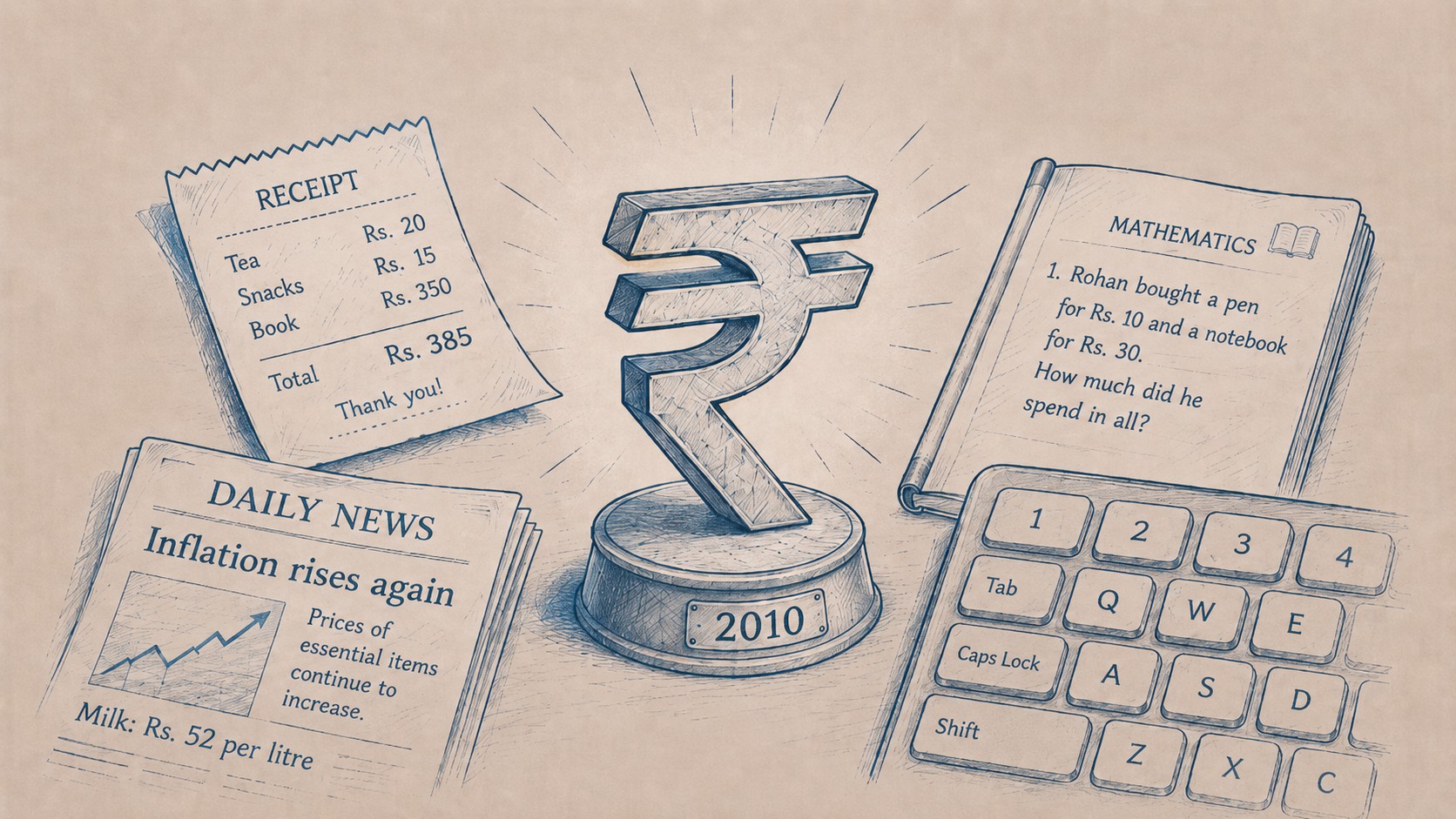
In July 2010, India did something it had never done before: it gave its currency a symbol of its own. Designed by D. Udaya Kumar, the ₹ sign elegantly fuses the Latin letter R with the Devanagari character र, topped with a double stroke that echoes the visual language of $ and £. It was a deliberate, confident act of national identity: the stated goal of the design contest was to “reflect and capture the Indian ethos and culture.”
Fifteen years later, open any Indian newspaper. Scroll through any news app. Read any government press release. The odds are good that you will find not ₹ but “Rs.”, an abbreviation that predates Indian independence, that has been officially deprecated, and that India shares with Pakistan, Nepal, Sri Lanka, Mauritius, and the Seychelles. The symbol designed to distinguish India’s rupee from every other rupee in the region sits largely unused.
How did this happen? Through a remarkable chain of institutional failures, each one compounding the last.
A brief history of “Rs.”
The word “rupee” entered common English usage around 1835, coined during British rule of the Indian subcontinent. Since the currency had no symbol, users improvised with an abbreviation: “Rs.” for rupees, “Re.” for the singular rupee. This workaround spread across the entire region that used the currency, embedding itself into typewriters, ledgers, and eventually computer keyboards.
When Unicode — the universal character encoding standard — was first published in 1991, it included a generic rupee sign (₨) to represent this entrenched abbreviation as a single character. But ₨ is still, fundamentally, an abbreviation in disguise: a ligature of the letters R and s. It was a workaround encoded as a symbol, not a true currency sign.
The ₹ sign changed that. After India approved it in 2010, the Unicode Consortium adopted it within months, a remarkably fast turnaround that reflected genuine international enthusiasm. On paper, India now had everything it needed: an official symbol, Unicode support, and a clear mandate to use it.
Rs.
Typed abbreviation
Deprecated
₨
Generic rupee sign
Deprecated
₹
Indian rupee sign
Correct
The keyboard that wasn’t
A currency symbol is only useful if people can type it. And here is where India’s government achieved something quietly extraordinary: it managed to fumble every single step of making that possible.
Pre-2010
2010
2010–present
Ongoing
The result: the symbol exists on the keyboard layout of a locale that almost nobody has activated, accessible via a shortcut that isn’t printed anywhere, on a physical key that gives no indication it does anything special. For all practical purposes, the ₹ sign was made inaccessible to the very people it was created for.
The newsroom that refused
Technology is only part of the story. Even among the technically capable — those who knew the symbol existed and could access it — institutional inertia proved equally powerful.
Style guides at major Indian news organizations continued to mandate “Rs.” long after 2010, treating the abbreviation as the correct form and the official symbol as an aberration. One outlet, when asked directly about the discrepancy, confirmed that its policy explicitly prohibited ₹ in favour of “Rs.”, offering no justification beyond the existence of the policy itself.
This matters because newsrooms set the standard for written language. When readers see “Rs.” in a national newspaper every day, they reasonably conclude that “Rs.” is correct. The institutional authority of journalism was actively working against adoption of the official symbol.
A news outlet, when contacted, confirmed that their style guide explicitly instructed journalists to use ‘Rs.’ not ₹. The symbol designed to replace the abbreviation had been banned by editorial policy.
It is worth noting that the problems with “Rs.” go beyond mere incorrectness. As a multi-character abbreviation rather than a single symbol, it is inherently inconsistent: some writers use “Rs.”, others “Rs”, others “rs.” or “rs” (lowercase). The dot is optional. The capitalization varies. A true symbol, ₹, has none of these failure modes. It is one character, always identical, always unambiguous.
Where things stand today
Usage of ₹ has improved noticeably in recent years, particularly in digital contexts. E-commerce platforms, banking apps, and payment services adopted it early; they only needed to add the character to their codebase once, so the technical barrier was trivially low. Journalism has improved since roughly 2020, with some major outlets now using ₹ consistently.
But “Rs.” persists widely: in print, in older digital properties, in government documents, and in the writing of anyone who learned their habits before the symbol became accessible. The improvement has been organic and uneven, not the result of any coordinated effort to enforce correct usage.
The ₹ sign is not a stylistic preference. It is now the official symbol of the Indian rupee, adopted by the Government of India and the Unicode Consortium. Using “Rs.” in its place is not informal or colloquial; it is incorrect, in the same way that writing “Ps.” or “Lb.” instead of £ in running text would be incorrect in a British publication.
India created a symbol to distinguish its currency from every other rupee in the world. Using that symbol is the least we can do to honour that intention. ∎
Want to type ₹ and other correct Indian English symbols easily? The Hita Keyboard layout puts the ₹ on the key where it belongs.
Leave a Reply